Nuvei Optimize is your always‑on optimization engine. It quietly improves your conversions, reduces declines and recovers revenue at every stage of the transaction journey. Activate only the modules that match your strategy—so you’re always getting smarter, more efficient payments.
Remove unnecessary friction without compromising compliance
By optimizing your authentication strategy up front, you can balance security with speed, especially in markets with evolving regulations. Smarter authentication means your customers sail through checkout while you keep regulators and issuers happy.
3D Secure optimization: support for global and local 3DS schemes keeps your customers’ experience smooth
Exemptions management: smart logic applies exemptions where they make sense, so your genuine customers aren’t burdened by unnecessary steps
Soft decline handling: automatically initiates the 3DS flow when issuers require authentication, giving you another chance to convert
Send transactions through the rails that work hardest for you
Get the most out of every payment with intelligent routing that matches transactions to the best‑performing bank, network or local scheme. It’s orchestration that does the hard work for you, so you see more approvals without lifting a finger.
Direct scheme connections: enjoy more control and faster decisions by connecting directly to card networks
Local scheme routing: route transactions through local rails like Debit Routing (US), Cartes Bancaires (FR) or Bancontact (BE) to increase acceptance in local markets
Bank routing: dynamic logic based on card type, region and performance data ensures every transaction takes the most effective path
Make the moment of truth work harder for you
This is where approvals happen—or don’t. You maximize success by making transactions cleaner, more complete and easier for issuers to approve. When every detail counts, you’ll benefit from precision and smart enrichment.
Partial approval: capture what’s available so you never lose the sale
Account updater: keep card‑on‑file credentials fresh automatically, minimizing declines due to outdated details
Recover revenue with smarter retries
Not every payment goes through the first time. With Nuvei Optimize, failed transactions don’t mean failed revenue. Retry tools quietly re‑attempt declined payments, switch banks or offer a fallback method—all without disrupting your customer’s experience.
Auth messaging: adjust how a retry is presented to increase issuer acceptance
CVV reattempts: give soft-declined payments a second chance by re-validating credentials
Bank cascading: instantly try a backup bank for better recovery
Payment recovery: offer the customer an alternative method to complete the purchase
Full visibility. Real-time impact
Stay in control of your performance with the data, tools and expert support needed to keep things moving forward—even as the payment landscape evolves. Real‑time insights and hands‑on guidance help you make data-driven decisions, quickly.
Real-time insights: see what’s working and what isn’t so you can act immediately
Conversion analysts: hands‑on experts helping you launch and optimize your payment flows for peak performance
Collaborative issuer relations: benefit from direct relationships with issuers to improve logic and deliver better outcomes for your business
MONTREAL and HANGZHOU, China, July 29, 2021 – Nuvei Corporation (“Nuvei”) (TSX: NVEI and NVEI.U), the global payment technology partner of thriving brands, and Alipay, the world’s leading digital payment platform operated by Ant Group, today announced a partnership that will connect Nuvei’s merchants with over 1.2 billion potential customers in the Asia Pacific region through the Alipay+ cross-border payment and merchant marketing solution. This includes access to a network of Asia’s leading local e-wallets.
Beginning in early 2020, Alipay started offering its partners a cross-border payment and merchant marketing solution, making it easy for businesses to accept different payment methods and conduct cost-effective digital marketing campaigns. The solution also makes it more convenient for users of Asia’s leading e-wallet service providers, including Alipay (Chinese mainland), AlipayHK (Hong Kong S.A.R.), Kakao Pay (Republic of Korea), GCash (the Philippines), TrueMoney (Thailand), DANA (Indonesia), and Touch ‘n Go (Malaysia) to transact easily with more businesses. In China, Alipay alone connects over 80 million businesses with more than one billion users.
Alipay and Nuvei are currently integrated for online purchases via hosted payment page or API, and its point-of-sale app for in-store purchases using a QR code. The adoption of the Alipay+ solution propels Nuvei to another level of global reach, further expanding its significant portfolio of payment methods. This enables Nuvei’s clients to seamlessly market to the Alipay+ network of e-wallet holders through a single API connection. Merchants will be able to accept one-time and recurring payments from Asia’s leading local e-wallet holders in the currency relevant to that payment method.
“We aim to consistently provide the most relevant payment options that open up more global commerce possibilities, expand our clients’ potential customer base and drive new revenue streams. Our partnership with Alipay is yet another testament to this goal,” said Philip Fayer, Nuvei’s Chair and CEO. “The APAC region is an economic powerhouse and very attractive to growth-minded businesses. We’re delighted to empower merchants to better market to this region while making the purchase experience as seamless as possible.”
“Alipay has always believed in global partnerships, supporting service providers to better serve their clients and unlock growth opportunities so that it becomes easier for merchants to do business anywhere,” said Yulei Wang, General Manager of Global Merchant Partnerships at Alipay. “With Nuvei’s integration into the Alipay+ solution, we look forward to enabling Nuvei to attract more Asian customers to its merchant network.”
About Nuvei
We are Nuvei (TSX: NVEI and NVEI.U), the global payment technology partner of thriving brands. We provide the intelligence and technology businesses need to succeed locally and globally, through one integration – propelling them further, faster. Uniting payment technology and consulting, we help businesses remove payment barriers, optimize operating costs and increase acceptance rates. Our proprietary platform provides seamless pay-in and payout capabilities, connecting merchants with their customers in 204 markets worldwide, with local acquiring in 45 markets. With support for over 480 local and alternative payment methods, nearly 150 currencies and 40 cryptocurrencies, merchants can capture every payment opportunity that comes their way. Our purpose is to make our world a local marketplace. For more information, visit www.nuvei.com.
About Alipay
Alipay is the leading digital payment platform in China, serving hundreds of millions of users, and connecting them with merchants and partner financial institutions that offer inclusive financial services and digital daily life services such as food delivery, transport, entertainment, and healthcare.
MONTREAL, February 24, 2021 – Nuvei Corporation (TSX: NVEI and NVEI.U), the global payment technology partner of thriving brands, today announced that it will release its fourth quarter and full year 2020 financial results before market open on Wednesday, March 10, 2021. Management will host a conference call and webcast at 8:30 am ET on Wednesday, March 10, 2021 to discuss the financial results. Hosting the call will be Philip Fayer, Chairman and CEO, and David Schwartz, CFO.
The conference call will be webcast live from the Company’s investor relations website at https://investors.nuvei.com under the “Events & Presentations” section. A replay will be available on the investor relations website following the call.
The conference call can also be accessed live over the phone by dialing 877-425-9470 (US/Canada toll-free), or 201-389-0878 (international). A replay will be available one hour after the call and can be accessed by dialing 844-512-2921 (US/Canada toll-free) or 412-317-6671 (international); the conference ID is 13715172. The replay will be available through Wednesday, March 24, 2021.
About Nuvei
We are Nuvei (TSX: NVEI and NVEI.U), the global payment technology partner of thriving brands. We provide the intelligence and technology businesses need to succeed locally and globally, through one integration – propelling them further, faster. Uniting payment technology and consulting, we help businesses remove payment barriers, optimize operating costs and increase acceptance rates. Our proprietary platform offers direct connections to all major payment card schemes in over 200 markets worldwide, supports 450 local and alternative payment methods and nearly 150 currencies. Our purpose is to make our world a local marketplace. For more information, visit www.nuvei.com.
Contact:
Investor Relations Anthony Gerstein Vice President, Head of Investor Relations agerstein@nuvei.com
MONTREAL, July 24, 2025 – Nuvei today announced the addition of PINless debit and Least Cost Routing to its Authorization Optimization suite, improving its authorization rate for merchants in North America by up to 3.5 percentage points for applicable transactions.
PINless debit and least cost routing are available now in the U.S., enabling eligible transactions to bypass traditional card rails in favor of lower-cost local debit networks. Nuvei continues to invest in foundational technology that uses artificial intelligence, machine learning, and data analytics to improve payment routing, augment transaction flows, and optimize revenue recovery.
“These enhancements give merchants access to debit networks that can deliver both higher approval rates and lower processing costs,” said Phil Fayer, Chair and CEO of Nuvei. “Our smart routing engine gives merchants the flexibility to prioritize maximum approvals or cost efficiency based on their business objectives. It’s about putting optimization in their hands and helping them turn payments into profit.”
These enhancements are a key part of Nuvei’s strategy to expand its footprint in North America by delivering locally optimized performance. As regulatory changes, issuer behavior, and consumer payment preferences evolve across the region, Nuvei’s intelligent routing and authorization tools give merchants the control and flexibility needed to drive higher approvals, lower costs, and accelerate growth in one of the world’s most competitive payments markets.
Smarter Routing That Drives Revenue
Nuvei’s smart routing engine uses real-time AI and machine learning to analyze every transaction and determine the most effective path to approval based on issuer behavior, network logic, card metadata, and regional preferences. Key routing capabilities include:
Intelligent Routing – Routes transactions through the best-performing bank or card network
PINless Debit Routing (U.S.) – Routes eligible debit cards through lower-cost networks, with fallback to Visa/Mastercard
With debit transactions now making up over 53% of online card volumes in North America and recent regulatory changes enabling multi-network routing, Nuvei’s enhanced smart routing helps merchants optimize margin, performance, and speed without adding operational complexity.
Intelligent Authorization That Maximizes Conversion
Nuvei’s intelligent authorization stack ensures that once a transaction reaches the right place, it has the highest possible chance of being approved. These features work together to reduce friction, resolve soft declines, and adapt in real time to issuer requirements:
Smart Auth Messaging – Dynamically configures payloads and message formats based on issuer-specific logic
Network Tokens – Increases issuer trust and compatibility through Visa and Mastercard network tokens
One-Click Payments – Accelerates repeat transactions with frictionless token-based experiences
Smart Retry That Recovers Revenue Instantly
If a transaction fails, Nuvei’s Smart Retry capabilities step in to recover revenue in real time, with no disruption to the customer experience. Built into the Authorization Optimization Suite, Smart Retry uses advanced decisioning logic to analyze failure reasons and automatically reattempt transactions through the most promising alternate paths.
Nuvei’s Smart Retry engine includes:
Account Updater – Automatically refreshes expired or replaced card credentials
Bank Failover Routing – Routes the transaction to a backup bank or APM if the primary path declines
Auth Reconfiguration – Modifies message format dynamically based on issuer response codes
Full Visibility and Control with AI-Powered Insights
Nuvei’s Control Layer provides merchants with deep visibility into performance, real-time alerts, and actionable analytics. By combining AI-powered tools with expert human support, Nuvei helps businesses not only understand how their payments are performing, but actively improve them.
Key analytics and insights tools include:
AI-Powered Approval Analysis – Automatically identifies unrealized approval opportunities by issuer, region, or transaction type
Performance Insights & Trend Monitoring – Tracks improvements in authorization success over time
Risk & Reporting Dashboards – Visualize fraud, scheme behavior, and exceptions in real time
About Nuvei
Nuvei is accelerating the business of clients around the world. Nuvei’s modular, flexible and scalable technology allows leading companies to accept next-gen payments, offer all payout options and benefit from card issuing, banking, risk and fraud management services. Connecting businesses to their customers in more than 200 markets, with local acquiring in 50 markets, 150 currencies and 720 alternative payment methods, Nuvei provides the technology and insights for customers and partners to succeed locally and globally with one integration.
MONTREAL, February 1, 2022 – Nuvei Corporation (Nasdaq: NVEI) (TSX: NVEI), the global payment technology partner of thriving brands, today announced it will release its financial results for the three months and year ended December 31, 2021 before market open on Tuesday, March 8, 2022. The Company also expects to provide its Financial Outlook for the three months ending March 31, 2022 and the year ending December 31, 2022.
Management will host a conference call and webcast to discuss these results at 8:30 am ET that same day. Hosting the call will be Philip Fayer, Chair and CEO, and David Schwartz, CFO.
The conference call will be webcast live from the Company’s investor relations website at https://investors.nuvei.com under the “Events & Presentations” section. A replay will be available on the investor relations website following the call.
The conference call can also be accessed live over the phone by dialing 877-425-9470 (US/Canada toll-free), or 201-389-0878 (international). A replay will be available one hour after the call and can be accessed by dialing 844-512-2921 (US/Canada toll-free), or 412-317-6671 (international); the conference ID is 13726674. The replay will be available through Tuesday, March 22, 2022.
About Nuvei
We are Nuvei (Nasdaq: NVEI) (TSX: NVEI), the global payment technology partner of thriving brands. We provide the intelligence and technology businesses need to succeed locally and globally, through one integration – propelling them further, faster. Uniting payment technology and consulting, we help businesses remove payment barriers, optimize operating costs and increase acceptance rates. Our proprietary platform provides seamless pay-in and payout capabilities, connecting merchants with their customers in over 200 markets worldwide, with local acquiring in 45 markets. With support for over 500 local and alternative payment methods, nearly 150 currencies and 40 cryptocurrencies, merchants can capture every payment opportunity that comes their way. Our purpose is to make our world a local marketplace.
MONTREAL and LONDON, March 29, 2021 – Nuvei Corporation (“Nuvei” or the “Company”) (TSX: NVEI and NVEI.U), the global payment technology partner of thriving brands, today announced it has added pay-in and payout support for nearly 40 of the world’s leading cryptocurrencies, including Bitcoin, Ethereum, Bitcoin Cash, Litecoin, NEO, Ripple and more. Now, eCommerce merchants can join the cryptocurrency revolution, offering innovative payment methods to access more customers around the world, even in previously hard to reach countries.
Mainstream adoption of cryptocurrencies has steadily increased, with the current estimated global market capitalization reaching approximately $1.6 trillion, according to CoinMarketCap. As the number of cryptocurrency holders continues to expand, merchants stand to grow their overall market share by accepting it as another alternative payment method (APM).
With consumer shopping habits trending increasingly more global – thanks to the ease of purchasing from any site in any country – supporting cryptocurrencies represents a sizable market opportunity for merchants to attract more buyers worldwide. Additionally, cryptocurrency payments are increasingly becoming more significant for industries offering large ticket and high volume goods and services.
“We’re excited to provide yet another pioneering solution that empowers our clients, large and small, with frictionless payment experiences and a greater opportunity to partake in a global marketplace,” said Philip Fayer, Nuvei’s chairman and CEO. “Nuvei continuously strives to offer the most relevant payment mediums for our clients and their customers. Our cryptocurrency support provides convenient, secure and instant transaction processing through a single integration.”
Active in over 200 global markets, Nuvei enables access to the most popular cryptocurrencies in addition to supporting nearly 150 local currencies and over 455 APMs. Merchants can now further conduct business across borders, as well as beyond the bounds of the fiat ecosystem. This provides the Company’s merchants with greater reach to consumers worldwide, and the agility to meet demand for additional payment preferences. They also benefit from enhanced security, privacy and integrity of transactions inherent with cryptocurrencies.
With the addition of cryptocurrencies to its platform, Nuvei can now also facilitate transactions for the world’s growing interest in Non-Fungible Tokens (NFTs) – certifiably singular digital files that represent tangible and intangible items, underpinned by blockchain technology. NFTs include digital artwork, videos, collectables and other one-of-a-kind assets for cryptocurrency art enthusiasts and investors. As of this year, total sales of NFTs have surpassed $174 million, according to NonFungible.com, which monitors the cryptocurrency collectable market.
We are Nuvei (TSX: NVEI and NVEI.U), the global payment technology partner of thriving brands. We provide the intelligence and technology businesses need to succeed locally and globally, through one integration – propelling them further, faster. Uniting payment technology and consulting, we help businesses remove payment barriers, optimize operating costs and increase acceptance rates. Our proprietary platform offers direct connections to all major payment card schemes in over 200 markets worldwide, supports 455 local and alternative payment methods, nearly 150 currencies and 40 cryptocurrencies. Our purpose is to make our world a local marketplace.
MONTREAL, April 26, 2023 – Nuvei Corporation (Nasdaq: NVEI) (TSX: NVEI), the Canadian fintech company, today announced it will release its first quarter 2023 financial results before market open on Wednesday, May 10, 2023. Management will host a conference call and webcast to discuss these results at 8:30 am ET that same day. Hosting the call will be Philip Fayer, Chair and CEO, and David Schwartz, CFO.
conference call will be webcast live from the Company’s investor relations website at https://investors.nuvei.com under the “Events & Presentations” section. An audio replay will be available on the investor relations website following the call.
The conference call can also be accessed live over the phone by dialing 877-425-9470 (US/Canada toll-free) or 201-389-0878 (international). An audio replay will be available approximately one hour after the call and can be accessed by dialing 844-512-2921 (US/Canada toll-free) or 412-317-6671 (international); the conference ID is 13737501. The audio replay will be available for two weeks, through Wednesday, May 24, 2023.
About Nuvei
Nuvei (Nasdaq: NVEI) (TSX: NVEI) is the Canadian fintech company accelerating the business of clients around the world. Nuvei’s modular, flexible and scalable technology allows leading companies to accept next-gen payments, offer all payout options and benefit from card issuing, banking, risk and fraud management services. Connecting businesses to their customers in more than 200 markets, with local acquiring in 45+ markets, 150 currencies and more than 600 alternative payment methods, Nuvei provides the technology and insights for customers and partners to succeed locally and globally with one integration.
Nuvei reports in U.S. dollars and in accordance with International Financial Reporting Standards (“IFRS”)
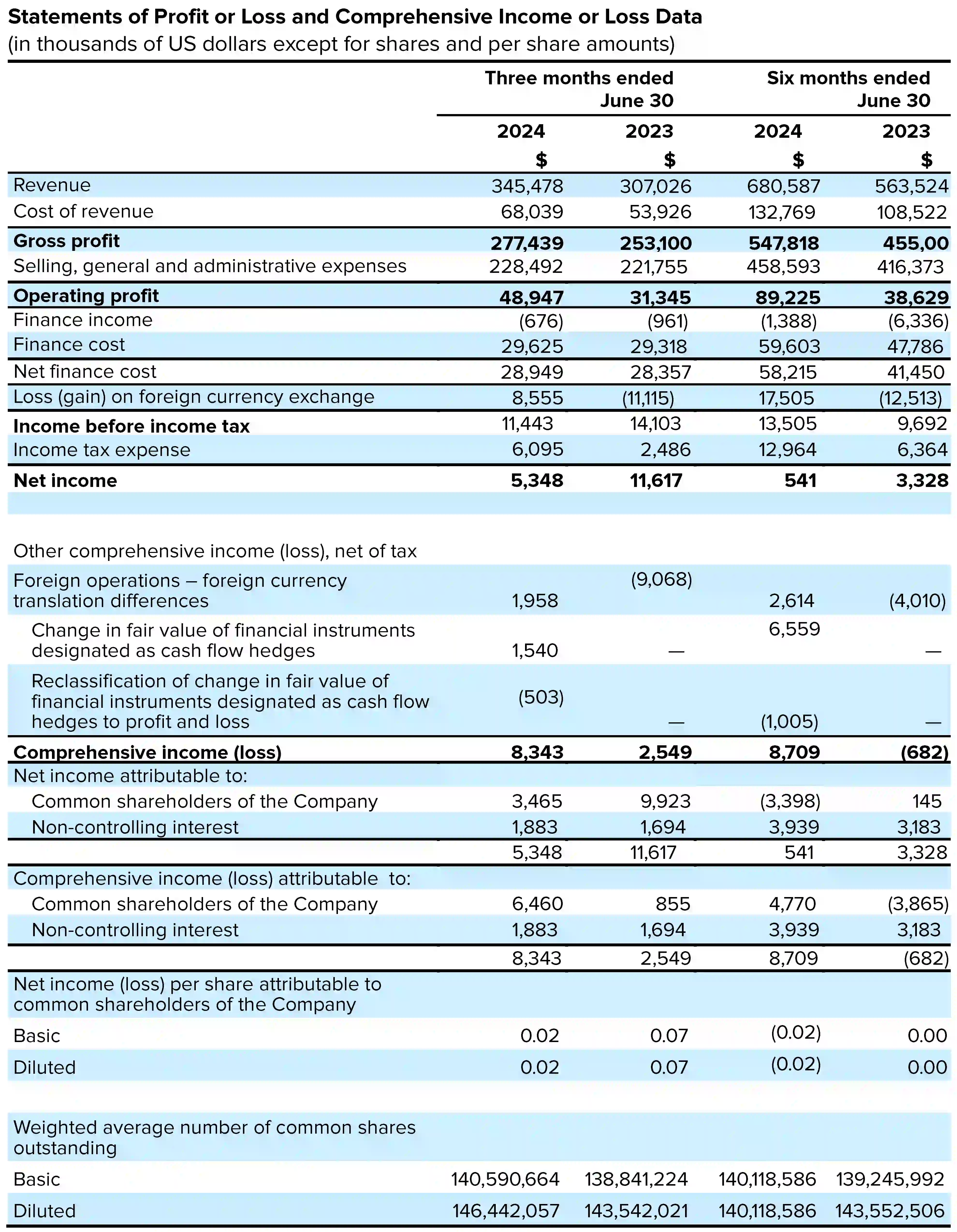
MONTREAL, AUGUST 6, 2024 – Nuvei Corporation (“Nuvei” or the “Company”) (Nasdaq: NVEI) (TSX: NVEI), the Canadian fintech company, today reported its financial results for the three and six months ended June 30, 2024.
Financial Highlights for the Three Months Ended June 30, 2024 Compared to 2023:
Total volume(a) increased by 22% to $61.7 billion from $50.6 billion;
Revenue increased by 13% to $345.5 million from $307.0 million;
Net income decreased by 54% to $5.3 million from $11.6 million;
Adjusted EBITDA(b) increased by 6% to $116.8 million from $110.3 million;
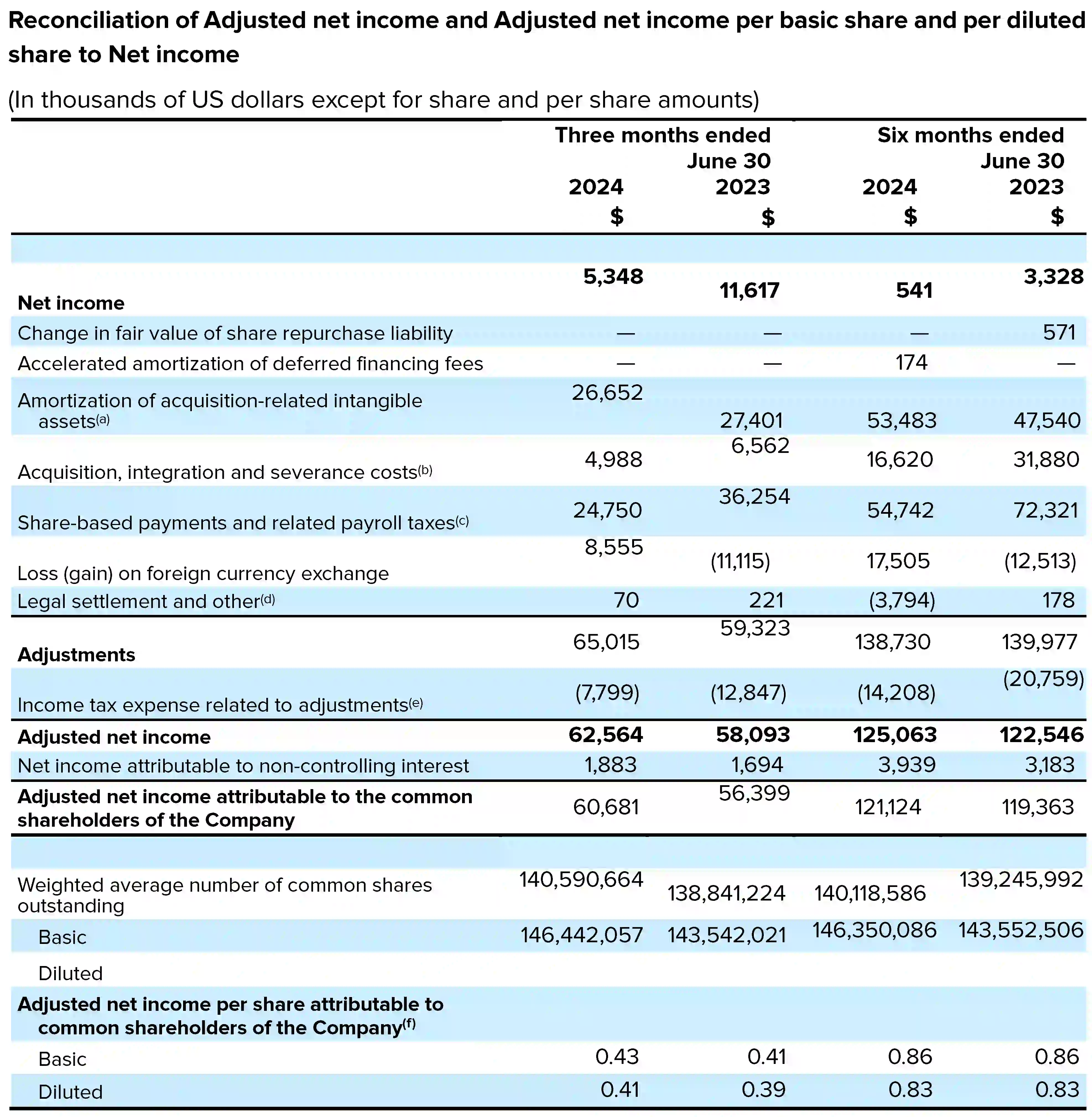
Adjusted net income(b) increased by 8% to $62.6 million from $58.1 million;
Net income per diluted share decreased to $0.02 from $0.07;
Adjusted net income per diluted share(b) increased by 5% to $0.41 from $0.39 ;
Adjusted EBITDA less capital expenditures(b) increased to $96.4 million from $95.9 million.
Financial Highlights for the Six Months Ended June 30, 2024 Compared to 2023:
Total volume(a) increased by 31% to $121.8 billion from $93.0 billion;
Revenue increased 21% to $680.6 million from $563.5 million;
Net income decreased by 84% to $0.5 million from $3.3 million;
Adjusted EBITDA(b) increased by 12% to $231.6 million from $206.6 million;
Adjusted net income(b) increased by 2% to $125.1 million from $122.5 million;
Net loss per diluted share was $0.02 compared to net income per diluted share of $0.00;
Adjusted net income per diluted share(b) was stable at $0.83;
Adjusted EBITDA less capital expenditures(b) increased by 9% to $195.5 million from $179.5 million; and,
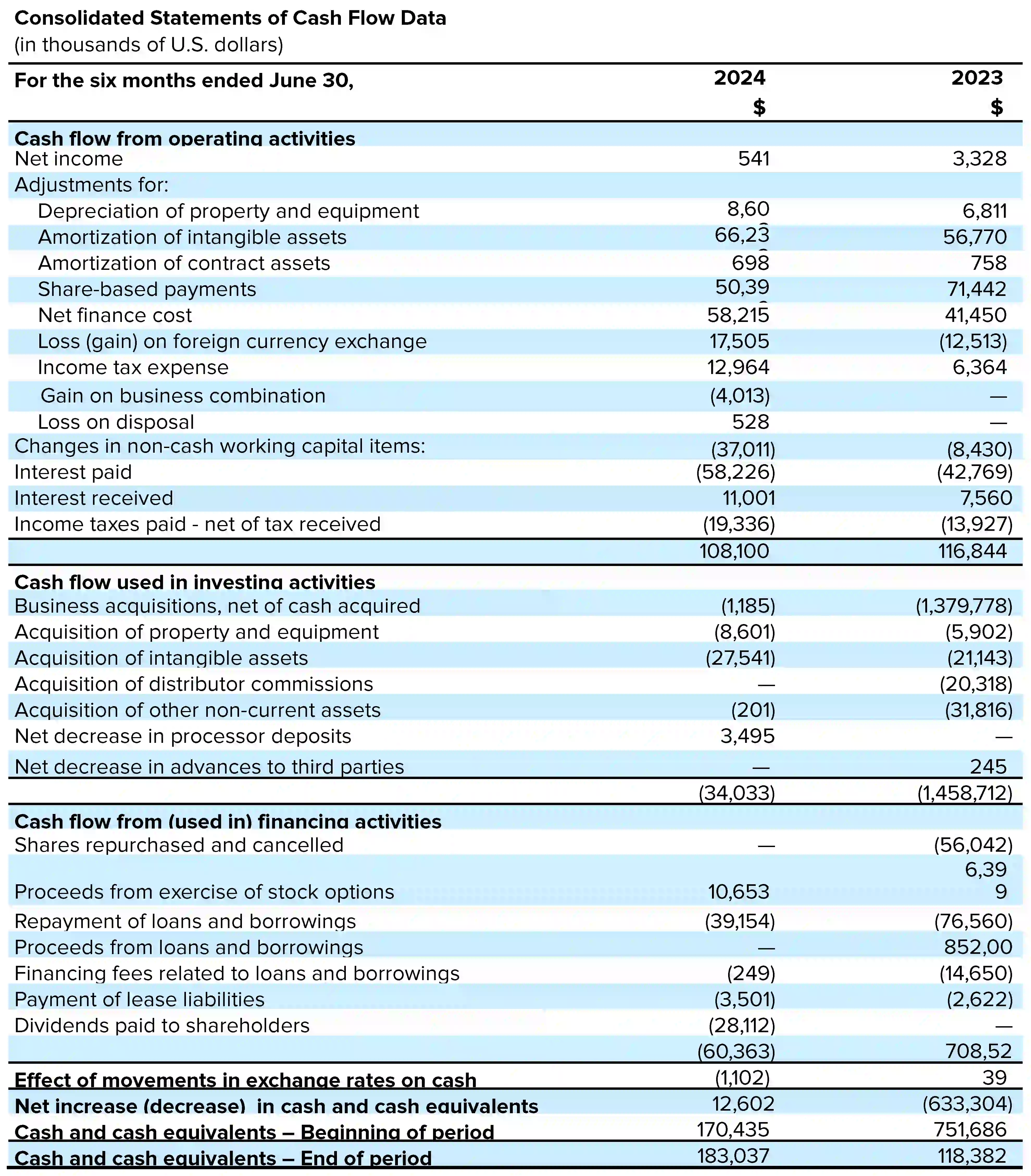
Cash dividends declared were $28.2 million.
(a) Total volume does not represent revenue earned by the Company, but rather the total dollar value of transactions processed by merchants under contractual agreement with the Company. See “Non-IFRS and Other Financial Measures”.
(b) Adjusted EBITDA, Adjusted EBITDA margin, Adjusted net income, Adjusted net income per diluted share and Adjusted EBITDA less capital expenditures are non-IFRS measures and non-IFRS ratios. These measures are not recognized measures under IFRS and do not have standardized meanings prescribed by IFRS and therefore may not be comparable to similar measures presented by other companies. See “Non-IFRS and Other Financial Measures”.
Proposed take private transaction
As previously announced, on April 1, 2024 the Company entered into a definitive arrangement agreement to be taken private by Advent International (“Advent”), one of the world’s largest and most experienced global private equity investors, as well as a longstanding sponsor in the payments space, alongside existing Canadian shareholders Philip Fayer, certain investment funds managed by Novacap Management Inc. and Caisse de dépôt et placement du Québec, in an all-cash transaction which values the Company at an enterprise value of approximately $6.3 billion (the “Proposed transaction”). Advent will acquire all the issued and outstanding Subordinate Voting Shares and any Multiple Voting Shares (collectively the “Shares”) that are not Rollover Shares , for a price of $34.00 per Share, in cash. This price represents an attractive and significant premium of approximately 56% to the closing price of the Subordinate Voting Shares on the Nasdaq Global Select Market (“Nasdaq”) on March 15, 2024, the last trading day prior to media reports concerning a potential transaction involving the Company, and a premium of approximately 48% to the 90-day volume weighted average trading price per Subordinate Voting Share as of such date.
The Proposed transaction will be implemented by way of a statutory plan of arrangement under the Canada Business Corporations Act. The Proposed transaction was approved by shareholders at a special meeting held on June 18, 2024 and received court approval on June 20, 2024. The proposed transaction remains subject to customary closing conditions, including receipt of key regulatory approvals (a number of which were received and/or for which the waiting period has expired as of the date hereof, with several approvals remaining outstanding), is not subject to any financing condition and, assuming the timely receipt of all required key regulatory approvals, is expected to close in late 2024 or the first quarter of 2025.
Following completion of the transaction, it is expected that the Subordinate Voting Shares will be delisted from each of the Toronto Stock Exchange and the Nasdaq and that Nuvei will cease to be a reporting issuer in all applicable Canadian jurisdictions and will deregister the Subordinate Voting Shares with the U.S. Securities and Exchange Commission (the “SEC”).
Cash Dividend
Nuvei today announced that its Board of Directors has authorized and declared a cash dividend of $0.10 per Subordinate Voting Share and Multiple Voting Share, payable on September 5, 2024 to shareholders of record on August 20, 2024. The aggregate amount of the dividend is expected to be approximately $14 million, to be funded from the Company’s existing cash on hand.
The Company, for the purposes of the Income Tax Act (Canada) and any similar provincial or territorial legislation, designates the dividend declared for the quarter ended June 30, 2024, and any future dividends, to be eligible dividends. The Company further expects to report such dividends as a dividend to U.S. shareholders for U.S. federal income tax purposes. Subject to applicable limitations, dividends paid to certain non-corporate U.S. shareholders may be eligible for taxation as “qualified dividend income” and therefore may be taxable at rates applicable to long-term capital gains. A U.S. shareholder should talk to its advisor regarding such dividends, including with respect to the “extraordinary dividend” provisions of the Internal Revenue Code (US).
The declaration, timing, amount and payment of future dividends remain at the discretion of the Board of Directors, as more fully described under the heading “Forward-Looking Information” of this press release.
Conference Call, Financial Outlook and Growth Targets
In light of the Proposed transaction, Nuvei no longer holds earnings conference calls or provides its financial outlook or growth targets.
About Nuvei
Nuvei (Nasdaq: NVEI) (TSX: NVEI) is the Canadian fintech company accelerating the business of clients around the world. Nuvei’s modular, flexible and scalable technology allows leading companies to accept next-gen payments, offer all payout options and benefit from card issuing, banking, risk and fraud management services. Connecting businesses to their customers in more than 200 markets, with local acquiring in 50 markets, 150 currencies and 716 alternative payment methods, Nuvei provides the technology and insights for customers and partners to succeed locally and globally with one integration.
Nuvei’s condensed interim consolidated financial statements have been prepared in accordance with IFRS applicable to the preparation of interim financial statements, including IAS 34, Interim Financial Reporting, as issued by the IASB. The information presented in this press release includes non-IFRS financial measures, non-IFRS financial ratios and supplementary financial measures, namely Adjusted EBITDA, Adjusted net income, Adjusted net income per basic share, Adjusted net income per diluted share, Adjusted EBITDA less capital expenditures and Total volume. These measures are not recognized measures under IFRS and do not have standardized meanings prescribed by IFRS and therefore may not be comparable to similar measures presented by other companies. Rather, these measures are provided as additional information to complement IFRS measures by providing further understanding of our results of operations from our perspective. Accordingly, these measures should not be considered in isolation nor as a substitute for analysis of the Company’s financial statements reported under IFRS. These measures are used to provide investors with additional insight of our operating performance and thus highlight trends in Nuvei’s business that may not otherwise be apparent when relying solely on IFRS measures. We also believe that securities analysts, investors and other interested parties frequently use these non-IFRS and other financial measures in the evaluation of issuers. We also use these measures to facilitate operating performance comparisons from period to period, to prepare annual operating budgets and forecasts and to determine components of management compensation. We believe these measures are important additional measures of our performance, primarily because they and similar measures are used widely among others in the payment technology industry as a means of evaluating a company’s underlying operating performance.
Non-IFRS Financial Measures
Adjusted EBITDA: We use Adjusted EBITDA as a means to evaluate operating performance, by eliminating the impact of non-operational or non-cash items. Adjusted EBITDA is defined as net income (loss) before finance costs (recovery), finance income, depreciation and amortization, income tax expense, acquisition, integration and severance costs, share-based payments and related payroll taxes, loss (gain) on foreign currency exchange, and legal settlement and other.
Adjusted EBITDA less capital expenditures: We use Adjusted EBITDA less capital expenditures (which we define as acquisition of intangible assets and property and equipment) as a supplementary indicator of our operating performance.
Adjusted net income: We use Adjusted net income as an indicator of business performance and profitability with our current tax and capital structure. Adjusted net income is defined as net income (loss) before acquisition, integration and severance costs, share-based payments and related payroll taxes, loss (gain) on foreign currency exchange, amortization of acquisition-related intangible assets, and the related income tax expense or recovery for these items. Adjusted net income also excludes change in redemption value of liability-classified common and preferred shares, change in fair value of share repurchase liability and accelerated amortization of deferred financing fees and legal settlement and other.
Non-IFRS Financial Ratios
Adjusted net income per basic share and per diluted share: We use Adjusted net income per basic share and per diluted share as an indicator of performance and profitability of our business on a per share basis. Adjusted net income per basic share and per diluted share means Adjusted net income less net income attributable to non-controlling interest divided by the basic and diluted weighted average number of common shares outstanding for the period, respectively. The number of share-based awards used in the diluted weighted average number of common shares outstanding in the Adjusted net income per diluted share calculation is determined using the treasury stock method as permitted under IFRS.
Supplementary Financial Measures
We monitor the following key performance indicators to help us evaluate our business, measure our performance, identify trends affecting our business, formulate business plans and make strategic decisions. Our key performance indicators may be calculated in a manner that differs from similar key performance indicators used by other companies.
Total volume: We believe Total volume is an indicator of performance of our business. Total volume and similar measures are used widely among others in the payments industry as a means of evaluating a company’s performance. We define Total volume as the total dollar value of transactions processed in the period by customers under contractual agreement with us. Total volume does not represent revenue earned by us. Total volume includes acquiring volume, where we are in the flow of funds in the settlement transaction cycle, gateway/technology volume, where we provide our gateway/technology services but are not in the flow of funds in the settlement transaction cycle, as well as the total dollar value of transactions processed relating to APMs and payouts. Since our revenue is primarily sales volume and transaction-based, generated from merchants’ daily sales and through various fees for value-added services provided to our customers, fluctuations in Total volume will generally impact our revenue.
Forward-Looking Information
This press release contains “forward-looking information” and “forward-looking statements” (collectively, “Forward-looking information”) within the meaning of applicable securities laws. Such forward-looking information may include, without limitation, information with respect to our objectives and the strategies to achieve these objectives, as well as information with respect to our beliefs, plans, expectations, anticipations, estimates and intentions. This forward-looking information is identified by the use of terms and phrases such as “may”, “would”, “should”, “could”, “expect”, “intend”, “estimate”, “anticipate”, “plan”, “foresee”, “believe”, or “continue”, the negative of these terms and similar terminology, including references to assumptions, although not all forward-looking information contains these terms and phrases. Particularly, information regarding our expectations of future results, performance, achievements, prospects or opportunities or the markets in which we operate, expectations regarding industry trends and the size and growth rates of addressable markets, our business plans and growth strategies, addressable market opportunity for our solutions, expectations regarding growth and cross-selling opportunities and intention to capture an increasing share of addressable markets, the costs and success of our sales and marketing efforts, intentions to expand existing relationships, further penetrate verticals, enter new geographical markets, expand into and further increase penetration of international markets, intentions to selectively pursue and successfully integrate acquisitions, and expected acquisition outcomes, cost savings, synergies and benefits, including with respect to the acquisition of Paya, future investments in our business and anticipated capital expenditures, our intention to continuously innovate, differentiate and enhance our platform and solutions, expected pace of ongoing legislation of regulated activities and industries, our competitive strengths and competitive position in our industry, and expectations regarding our revenue, revenue mix and the revenue generation potential of our solutions and expectations regarding our margins and future profitability, as well as statements regarding the Proposed transaction with Advent International L.P., alongside existing Canadian shareholders Philip Fayer, certain investment funds managed by Novacap Management Inc., and Caisse de dépôt et placement du Québec, including the proposed timing and various steps contemplated in respect of the transaction and statements regarding the plans, objectives, and intentions of Philip Fayer, certain investment funds managed by Novacap Management Inc., Caisse de dépôt et placement du Québec or Advent, are forward-looking information. Economic and geopolitical uncertainties, including regional conflicts and wars, including potential impacts of sanctions, may also heighten the impact of certain factors described herein.
In addition, any statements that refer to expectations, intentions, projections or other characterizations of future events or circumstances contain forward-looking information. Statements containing forward-looking information are not historical facts but instead represent management’s expectations, estimates and projections regarding future events or circumstances.
Forward-looking information is based on management's beliefs and assumptions and on information currently available to management, regarding, among other things, assumptions regarding foreign exchange rate, competition, political environment and economic performance of each region where the Company operates and general economic conditions and the competitive environment within our industry, including the following assumptions: (a) the Company will continue to effectively execute against its key strategic growth priorities, without any material adverse impact from macroeconomic or geopolitical headwinds on its or its customers' business, financial condition, financial performance, liquidity or any significant reduction in demand for its products and services, (b) the economic conditions in our core markets, geographies and verticals, including resulting consumer spending and employment, remaining at close to current levels, (c) assumptions as to foreign exchange rates and interest rates, including inflation, (d) the Company's continued ability to manage its growth effectively, (e) the Company's ability to continue to attract and retain key talent and personnel required to achieve its plans and strategies, including sales, marketing, support and product and technology operations, in each case both domestically and internationally, (f) the Company’s ability to successfully identify, complete, integrate and realize the expected benefits of past and recent acquisitions and manage the associated risks, as well as future acquisitions, (g) the absence of adverse changes in legislative or regulatory matters, (h) the Company’s continued ability to upskill and modify its compliance capabilities as regulations change or as the Company enters new markets or offers new products or services, (i) the Company’s continued ability to access liquidity and capital resources, including its ability to secure debt or equity financing on satisfactory terms, and (j) the absence of adverse changes in current tax laws. Unless otherwise indicated, forward-looking information does not give effect to the potential impact of any mergers, acquisitions, divestitures or business combinations that may be announced or closed after the date hereof. Although the forward-looking information contained herein is based upon what we believe are reasonable assumptions, investors are cautioned against placing undue reliance on this information since actual results may vary from the forward-looking information.
Forward-looking information involves known and unknown risks and uncertainties, many of which are beyond our control, that could cause actual results to differ materially from those that are disclosed in or implied by such forward-looking information. These risks and uncertainties include, but are not limited to, the risk factors described in greater detail under “Risk Factors” of the Company's annual information form ("AIF") and the “Risk Factor’s” in the Company’s management’s discussion and analysis of financial condition and results of operations for the three months ended June 30, 2024 (“MD&A”), such as: risks relating to our business, industry and overall economic uncertainty; the rapid developments and change in our industry; substantial competition both within our industry and from other payments providers; challenges implementing our growth strategy; challenges to expand our product portfolio and market reach; changes in foreign currency exchange rates, interest rates, consumer spending and other macroeconomic factors affecting our customers and our results of operations; challenges in expanding into new geographic regions internationally and continuing our growth within our markets; challenges in retaining existing customers, increasing sales to existing customers and attracting new customers; reliance on third-party partners to distribute some of our products and services; risks associated with future acquisitions, partnerships or joint-ventures; challenges related to economic and political conditions, business cycles and credit risks of our customers, such as wars like the Russia-Ukraine and Middle East conflicts and related economic sanctions; the occurrence of a natural disaster, a widespread health epidemic or pandemic or other similar events; history of net losses and additional significant investments in our business; our level of indebtedness; challenges to secure financing on favorable terms or at all; difficulty to maintain the same rate of revenue growth as our business matures and to evaluate our future prospects; inflation; challenges related to a significant number of our customers being small and medium businesses ("SMBs"); a certain degree of concentration in our customer base and customer sectors; compliance with the requirements of payment networks; reliance on, and compliance with, the requirements of acquiring banks and payment networks; challenges related to the reimbursement of chargebacks from our customers; financial liability related to the inability of our customers (merchants) to fulfill their requirements; our bank accounts being located in multiple territories and relying on banking partners to maintain those accounts; decline in the use of electronic payment methods; loss of key personnel or difficulties hiring qualified personnel; deterioration in relationships with our employees; impairment of a significant portion of intangible assets and goodwill; increasing fees from payment networks; misappropriation of end-user transaction funds by our employees; frauds by customers, their customers or others; coverage of our insurance policies; the degree of effectiveness of our risk management policies and procedures in mitigating our risk exposure; the integration of a variety of operating systems, software, hardware, web browsers and networks in our services; the costs and effects of pending and future litigation; various claims such as wrongful hiring of an employee from a competitor, wrongful use of confidential information of third parties by our employees, consultants or independent contractors or wrongful use of trade secrets by our employees of their former employers; deterioration in the quality of the products and services offered; managing our growth effectively; challenges from seasonal fluctuations on our operating results; changes in accounting standards; estimates and assumptions in the application of accounting policies; risks associated with less than full control rights of some of our subsidiaries and investments; challenges related to our holding company structure; impacts of climate change; development of AI and its integration in our operations, as well as risks relating to intellectual property and technology, risks related to data security incidents, including cyber-attacks, computer viruses, or otherwise which may result in a disruption of services or liability exposure; challenges regarding regulatory compliance in the jurisdictions in which we operate, due to complex, conflicting and evolving local laws and regulations and legal proceedings and risks relating to our Subordinate Voting Shares. These risks and uncertainties further include (but are not limited to) as concerns the Proposed transaction with Advent, the failure of the parties to obtain the necessary regulatory approvals or to otherwise satisfy the conditions to the completion of the transaction, failure of the parties to obtain such approvals or satisfy such conditions in a timely manner, significant transaction costs or unknown liabilities, failure to realize the expected benefits of the transaction, and general economic conditions. Failure to obtain the necessary shareholder, regulatory and court approvals, or the failure of the parties to otherwise satisfy the conditions to the completion of the transaction or to complete the transaction, may result in the transaction not being completed on the proposed terms, or at all. In addition, if the transaction is not completed, and the Company continues as a publicly-traded entity, there are risks that the announcement of the Proposed transaction and the dedication of substantial resources of the Company to the completion of the transaction could have an impact on its business and strategic relationships (including with future and prospective employees, customers, suppliers and partners), operating results and activities in general, and could have a material adverse effect on its current and future operations, financial condition and prospects. Furthermore, in certain circumstances, the Company may be required to pay a termination fee pursuant to the terms of the arrangement agreement which could have a material adverse effect on its financial position and results of operations and its ability to fund growth prospects and current operations.
Our dividend policy is at the discretion of the Board. Any future determination to declare cash dividends on our securities will be made at the discretion of our Board, subject to applicable Canadian laws, and will depend on a number of factors, including our financial condition, results of operations, capital requirements, contractual restrictions (including covenants contained in our credit facilities), general business conditions and other factors that our Board may deem relevant. Further, our ability to pay dividends, as well as make share repurchases, will be subject to applicable laws and contractual restrictions contained in the instruments governing our indebtedness, including our credit facility. Any of the foregoing may have the result of restricting future dividends or share repurchases.
Consequently, all of the forward-looking information contained herein is qualified by the foregoing cautionary statements, and there can be no guarantee that the results or developments that we anticipate will be realized or, even if substantially realized, that they will have the expected consequences or effects on our business, financial condition or results of operation. Unless otherwise noted or the context otherwise indicates, the forward-looking information contained herein represents our expectations as of the date hereof or as of the date it is otherwise stated to be made, as applicable, and is subject to change after such date. However, we disclaim any intention or obligation or undertaking to update or amend such forward-looking information whether as a result of new information, future events or otherwise, except as may be required by applicable law.
(i) professional, legal, consulting, accounting and other fees and expenses related to our acquisition and financing activities, including the expenses related to the Proposed transaction. For the three months and six months ended June 30, 2024, these expenses were $4.2 million and $14.5 million ($1.1 million and $19.6 million for the three months and six months ended June 30, 2023). These costs are presented in the professional fees line item of selling, general and administrative expenses.
(ii) acquisition-related compensation was $0.6 million and $1.7 million for the three months and six months ended June 30, 2024 and $0.7 million and $2.8 million for the three months and six months ended June 30, 2023. These costs are presented in the employee compensation line item of selling, general and administrative expenses.
(iii) change in deferred purchase consideration for previously acquired businesses. No amount was recognized for the three months and six months ended June 30, 2024 and 2023. These amounts are presented in the contingent consideration adjustment line item of selling, general and administrative expenses.
(iv) severance and integration expenses, which were $0.2 million and $0.5 million for the three months and six months ended June 30, 2024 ($4.8 million and $9.5 million for three months and six months ended June 30, 2023). These expenses are presented in selling, general and administrative expenses and cost of revenue.
(b) These expenses are recognized in connection with stock options and other awards issued under share-based plans as well as related payroll taxes that are directly attributable to share-based payments. For the three months and six months ended June 30, 2024, the expenses consisted of non-cash share-based payments of $20.6 million and $50.4 million ($35.9 million and $71.4 million for the three months and six months ended June 30, 2023), $4.1 million and $4.3 million for related payroll taxes ($0.4 million and $0.9 million for the three months and six months ended June 30, 2023),
(c) This primarily represents legal settlements and associated legal costs, as well as non-cash gains, losses and provisions and certain other costs. These costs are presented in selling, general and administrative expenses. For the six months ended June 30, 2024, the gain consisted mainly of a gain on business combination of $4.0 million.
(a) This line item relates to amortization expense taken on intangible assets created from the purchase price adjustment process on acquired companies and businesses and resulting from a change in control of the Company.
(b) These expenses relate to:
(i) professional, legal, consulting, accounting and other fees and expenses related to our acquisition and financing activities, including the expenses related to the Proposed transaction. For the three months and six months ended June 30, 2024, these expenses were $4.2 million and $14.5 million ($1.1 million and $19.6 million for the three months and six months ended June 30, 2023). These costs are presented in the professional fees line item of selling, general and administrative expenses.
(ii) acquisition-related compensation was $0.6 million and $1.7 million for the three months and six months ended June 30, 2024 and $0.7 million and $2.8 million for the three months and six months ended June 30, 2023. These costs are presented in the employee compensation line item of selling, general and administrative expenses.
(iii) change in deferred purchase consideration for previously acquired businesses. No amount was recognized for the three months and six months ended June 30, 2024 and 2023. These amounts are presented in the contingent consideration adjustment line item of selling, general and administrative expenses.
(iv) severance and integration expenses, which were $0.2 million and $0.5 million for the three months and six months ended June 30, 2024 ($4.8 million and $9.5 million for the three months and six months ended June 30, 2023). These expenses are presented in selling, general and administrative expenses and cost of revenue.
(c) These expenses are recognized in connection with stock options and other awards issued under share-based plans as well as related payroll taxes that are directly attributable to share-based payments. For the three months and six months ended June 30, 2024, the expenses consisted of non-cash share-based payments of $20.6 million and $50.4 million ($35.9 million and $71.4 million for the three months and six months ended June 30, 2023), $4.1 million and $4.3 million for related payroll taxes ($0.4 million and $0.9 million for the three months and six months ended June 30, 2023).
(d) This primarily represents legal settlements and associated legal costs, as well as non-cash gains, losses and provisions and certain other costs. These costs are presented in selling, general and administrative expenses. For the three months ended June 30, 2024, the gain consisted mainly of a gain on business combination of $4.0 million.
(e) This line item reflects income tax expense on taxable adjustments using the tax rate of the applicable jurisdiction.
(f) The number of share-based awards used in the diluted weighted average number of common shares outstanding in the Adjusted net income per diluted share calculation is determined using the treasury stock method as permitted under IFRS.
[1] Philip Fayer, Novacap and CDPQ (together with entities they control directly or indirectly, collectively, the "Rollover Shareholders") have agreed to roll approximately 95%, 65% and 75%, respectively, of their Shares (the "Rollover Shares") and are expected to receive in aggregate approximately US$560 million in cash for the Shares sold on closing. Philip Fayer, Novacap and CDPQ are expected to indirectly own or control approximately 24%, 18% and 12%, respectively, of the equity in the resulting private company. Percentages and amount of expected cash proceeds are based on current assumed cash position and are subject to change as a result of cash generated before closing.
There are hundreds of different payment methods ranging from credit cards and bank transfers to crypto and cash.
Previously dominated by cash, today payments is fueled by digital alternatives that typically involve a virtual wallet or card on a phone.
Digital payments driven by the likes of Apple Pay, PayPal, or Alipay are predicted to be the fastest growing payment globally. The CAGR of such digital wallet transactions in e-commerce, for example, is estimated to be 15 percent between 2023 and 2027.
Businesses must offer these convenient and preferred payment options to meet customer expectations and ensure smooth transactions.
In this blog, we'll cover various payment methods, their pros and cons, and factors to consider when choosing the right payment methods.
What are payment methods?
Payment methods offer various options for customers to pay businesses for products or services, both in physical and online stores.
Payment methods include cash, credit cards, debit cards, gift cards, and mobile payments, enabling smooth transactions based on customer convenience and preference.
They enable economic activities across e-commerce, in-person, and other business types.
Understanding payments
Payments transfer value between parties, often following an invoice. Payees choose the method, but legal tender laws apply. Foreign currency payments may incur extra fees.
Before currency, barter was common. Goods and services were exchanged directly. For instance, a farmer could trade eggs with another farmer for wheat.
Today's monetary system simplifies transactions with currency, providing a convenient, storable approach for payments.
Offering the most popular payment methods like credit cards, PayPal, Apple Pay, Google Pay, and cryptocurrencies is crucial for meeting diverse customer preferences.
Providing the right payment method ensures customers pay.
To capture new market opportunities, businesses should accept local payment methods critical for customer engagement and sales growth.
Reducing payment fraud
Selecting payment methods aligned with risk tolerance and robust customer authentication decreases the risk of payment fraud. Better levels of customer authentication will reduce the chances of fraud cases and chargebacks.
Competitive edge over other businesses
Merchants that accept multiple payment methods can differentiate in a competitive environment and convert prospects into customers. It is not uncommon for customers to switch to a different business that meets their payment expectations.
Different types of payment methods
Card payments
Credit card payments
Credit cards provide users with a line of credit up to a set limit. This specifies their maximum spending allowance. Each use of the card entails agreeing to repay the balance, often with interest.
When used, account information is sent to the merchant bank for authorization from the credit card network to process transactions.
Common credit card issuers include: Visa, Mastercard and American Express.
Advantages of credit cards
Establish a credit history and trust for future large purchases.
Lower risk compared to carrying cash.
Earn rewards like points, airline miles or cashback.
Provide deferred payment options.
Flexibility to make purchases now and pay later.
Enhanced Fraud Protection.
Disadvantages of credit cards
Risk of overextending credit and debt accumulation.
High processing fees for the merchant.
High interest rates on unpaid balances (15% to 25% APR).
Debit card payments
A debit card links directly to a bank account, allowing access only to available funds for purchases or withdrawals. If funds are insufficient, debit card transactions will be declined for purchases.
Debit cards offer conveniences similar to credit cards: easy portability, broad business acceptance, and diverse levels of fraud protection. They offer the convenience of cashless transactions and provide expense tracking capabilities.
Unlike credit, debit cards typically offer fewer promotional benefits and can incur fees if users inadvertently overdraw their account.
Advantages of debit cards
Facilitate easy transactions via ATM withdrawals or purchases at major retailers.
Usually no annual fees and transaction costs with sufficient account funds.
Promote responsible spending by limiting purchases to available balance.
Do not accrue interest as payments utilize the spender's own funds.
Transactions are logged to assist with budgeting.
Disadvantages of debit cards
Debit cards often offer limited fraud protection for specific amounts or periods.
They restrict spending to available balances, preventing excess in emergencies.
Banks may charge overdraft fees if funds exceed the account balance.
They do not contribute to building a credit score due to their use of available funds.
Debit cards offer fewer rewards and perks compared to credit cards due to their focus on direct access to funds rather than credit lines.
Credit and debit cards allow customers to pay via a card machine using chip & PIN or contactless. This can also be over the phone or an online transaction. The money is withdrawn directly from their bank account, typically processed within the same day. However, it can sometimes take 48-72 hours to process.
Prepaid card payments
Prepaid cards serve as an alternative to cash, functioning similarly to debit and credit cards. They allow for online and in-store payments via Chip and PIN or contactless methods.
The card is loaded with funds and can be topped up when required.
Advantages of prepaid cards
No linked bank account is required for cardholders.
The flexibility of traditional payment cards is available without the risk of accruing debt.
Adding specific funds to the prepaid card makes it easier to control spending.
Disadvantages of prepaid cards.
Needing to reload a card is inconvenient.
Contactless payments
By card
Most cards now support contactless payments. This method enables transactions without needing a PIN code. The card machines have contactless technology, allowing transactions to process simply be tap and go.
Contactless payments can be made with credit and debit cards or mobile devices. The concern is how easy it is for a thief to use someone else's card. Therefore, contactless transactions are limited.
By smartphone/digital wallets
Digital wallets, which also cover mobile wallets or e-wallets, are apps that store payment card information on smartphones or wearable devices. Digital wallets can store multiple payment types, including credit cards, debit cards, and bank transfers.
This turns the device into a wallet, enabling contactless payments with compatible card readers.
The credit or debit card machine, known as a point of sale terminal (POS), reads the customer's banking information via the mobile device's software application.
The phone reads the POS terminal information and generates a signal to confirm the payment.
This method allows for enhanced security measures in contactless transactions. Biometric requirements like fingerprint or facial recognition may be needed to confirm payment.
Biometric requirements in digital wallets address theft concerns associated with contactless card payments.
The technology uses Radio Frequency Identification (RFID) and Near Field Communication (NFC).
Advantages of mobile payments include:
Rapid transactions with a simple tap for authentication.
Eliminates the need to carry extra items, provided the user has their phone.
Enhanced financial security via tokenized apps, and additional safety with biometric authentication on devices.
Disadvantages of mobile payments include:
Dependency on specific types of mobile phones.
Risk of losing access to funds if phone is lost or faulty tech, and requirement to use specific apps at certain merchants (e.g., Apple Pay at Apple stores).
Connectivity issues can also arise.
Cryptocurrencies
Cryptocurrencies such as Bitcoin and Ethereum are increasingly popular as digital payment methods. They utilize cryptographic security, providing anonymity, but face challenges like price volatility and regulatory oversight.
Cryptocurrencies use decentralized networks called blockchains, which are databases that grow continuously with records called blocks.
Each block holds data about all cryptocurrency transactions, including when they occurred. This setup differs from traditional debit or credit cards.
When customers make online purchases with cryptocurrency, they transfer a set amount from their digital wallet to the merchant's. This transaction is recorded on the blockchain for transparency and security.
Improvements in blockchain technology and security measures have led to broader adoption for legitimate purposes. Businesses, from online retailers to tech firms and even some physical stores, now take cryptocurrencies as payment.
Advantages of cryptocurrencies include:
Global access thanks to international transactions.
Operates on decentralized ledgers.
Strong encryption and blockchain technology.
Easily adapts to preferred digital currencies via centralized or decentralized exchanges.
Bank account is not needed.
Faster payments.
Disadvantages of cryptocurrencies include:
Cryptocurrencies can fluctuate in value, potentially leading to capital loss.
Sending funds requires technical know-how and familiarity with the crypto platforms.
Mistakes can lead to fund loss.
They aren't as widely accepted for payments as other methods.
Cheques
Cheques function as paper vouchers linked to a current account, often used for bill payments or paying tradespeople. The payee deposits the cheque at their bank to complete the transaction.
Cheques provide a clear payment history and allow for delayed processing. However, they carry risks like bounced cheque. The process can also be tedious with having to write, male, and deposit.
Advantages of cheques include:
They allow for delayed payment for goods and services.
They provide a paper trail for transactions which can serve as proof.
There's less risk of theft compared to cash.
Low to no fees apart from the cost of the check and postage.
Offers protection since recipients must sign them and often show ID to cash them.
Disadvantages of cheques include:
Processing time as They can take time to clear.
Manual handling and deposit.
Risk of bounced or forged cheques.
Longer processing time as funds are only transferred when the recipient cashes the cheque.
Fraudulent cheques can be cashed with just a forged signature if the depositing bank does not verify ID.
Autopay
An autopay system automatically deducts funds from the user's bank account, credit card, or debit card on a scheduled date, typically monthly.
It's commonly used for recurring payments like credit card bills, utilities, subscriptions, and donations.
Autopay ensures payments are made on time, but it requires sufficient funds in bank accounts. Keeping track of spend is key as there is a risk of forgetting payments or overdrawing the account.
Advantages of autopay
Scheduled automatic purchases increase convenience and customer retention.
Timely payments prevents missing important bills like phone service and utilities.
Simplifies maintaining online subscriptions.
Disadvantages of autopay
Suitable only for periodic transactions, not one-time purchases.
Lack of oversight on individual payments.
Requires frequent account checks to ensure availability of funds.
Pay by Bank or Bank to Bank
Pay-by-bank lets customers make online purchases directly from their bank accounts without a credit or debit card. They use online banking credentials to authorize and transfer funds.
Advantages of pay by bank
It enhances security by eliminating the need to provide credit or debit card details, reducing fraud risk and protecting customer data.
Pay-by-bank is convenient for customers without credit or debit cards or those who prefer not to use them online. It speeds up checkout by eliminating the need to enter payment details for every purchase.
Pay-by-bank offers faster payment processing, with real-time transactions that help merchants receive payments quickly. This improves cash flow and simplifies payment reconciliation.
Disadvantages of pay by bank
Bank transfers aren't ideal for everyday or small online purchases because they can take several days to process, delaying transactions unnecessarily.
They can also face other delays, errors, or cancellations due to human or technical issues.
Cash payments
Cash remains a staple in retail, with supermarkets, cafes, and local businesses accepting it. Many small businesses favor cash due to lower transaction fees. However, cash poses risks like loss, theft, and damage, prompting extra costs for security measures.
Advantages of cash payments
Avoid hidden fees since cash transactions typically have no additional costs.
Helps manage spending by limiting purchases to the amount of cash on hand.
Aids in budgeting by providing a clear view of available funds.
Doesn't require internet access or technology for transactions.
Disadvantages of cash payments
Cash transactions don't contribute to building your credit score.
It lacks the ability to track spending like digital methods do.
Cash poses a higher risk of theft since it's owned by whoever holds it.
ATM withdrawals can result in fees.
What is the best payment method?
No single best form of payment exists, as each has its pros and cons. Traditional payment methods like cash are widely accepted. However, modern payment methods offer less risk of theft.
Merchants must cater to their customers' preferred payment methods. Convenience and a smooth payment experience are crucial.
Choosing the best payment methods for your business
When selecting payment methods for your customers, consider several factors. Not all methods suit every business and demographic.
Geographical location
The geographical location of your business and target audience influences which payment options to offer, as preferences vary by region. Identify available options in your areas and determine the most widely accepted methods for your customers.
Security and compliance
Ensure payment methods are secure and compliant with industry standards and regulations, protecting your business and customers by adhering to data protection and privacy rules.
Payment method vs business model
Tailor payment methods to your business model; subscription-based services benefit from recurring billing and automatic payments, while e-commerce platforms need secure online gateways and seamless checkouts.
Determine whether transactions are primarily online, in-store, or both, offering appropriate methods like digital payments for online businesses and card payments or cash for brick-and-mortar stores.
Future plans
Choose solutions that support your growth plans and future expansion, ensuring they integrate seamlessly with your existing systems, such as websites, POS systems, or mobile applications.
Conclusion
There is no single best payment method for your business, as each has its own advantages and disadvantages.
The key thing must be to prioritize your customers' preferred payment method and ensure a smooth and convenient payment experience.
Consider factors like geographical location, business model, and transaction type when selecting payment methods. Ensure security and compliance, and choose scalable solutions that integrate seamlessly with your existing systems to support future growth and expansion.