“Everybody’s business, nobody’s job”: How software companies turn embedded payments into a growth business
Lessons from Nuvei and ECI on what it takes to move payments from a feature to a business.
Payments used to be treated as a feature.
A checkout here, a card form there, maybe a recurring billing flow if the software company was feeling ambitious.
But for many software businesses, payments are becoming something much bigger: a growth engine, a retention tool, and a business line in its own right.
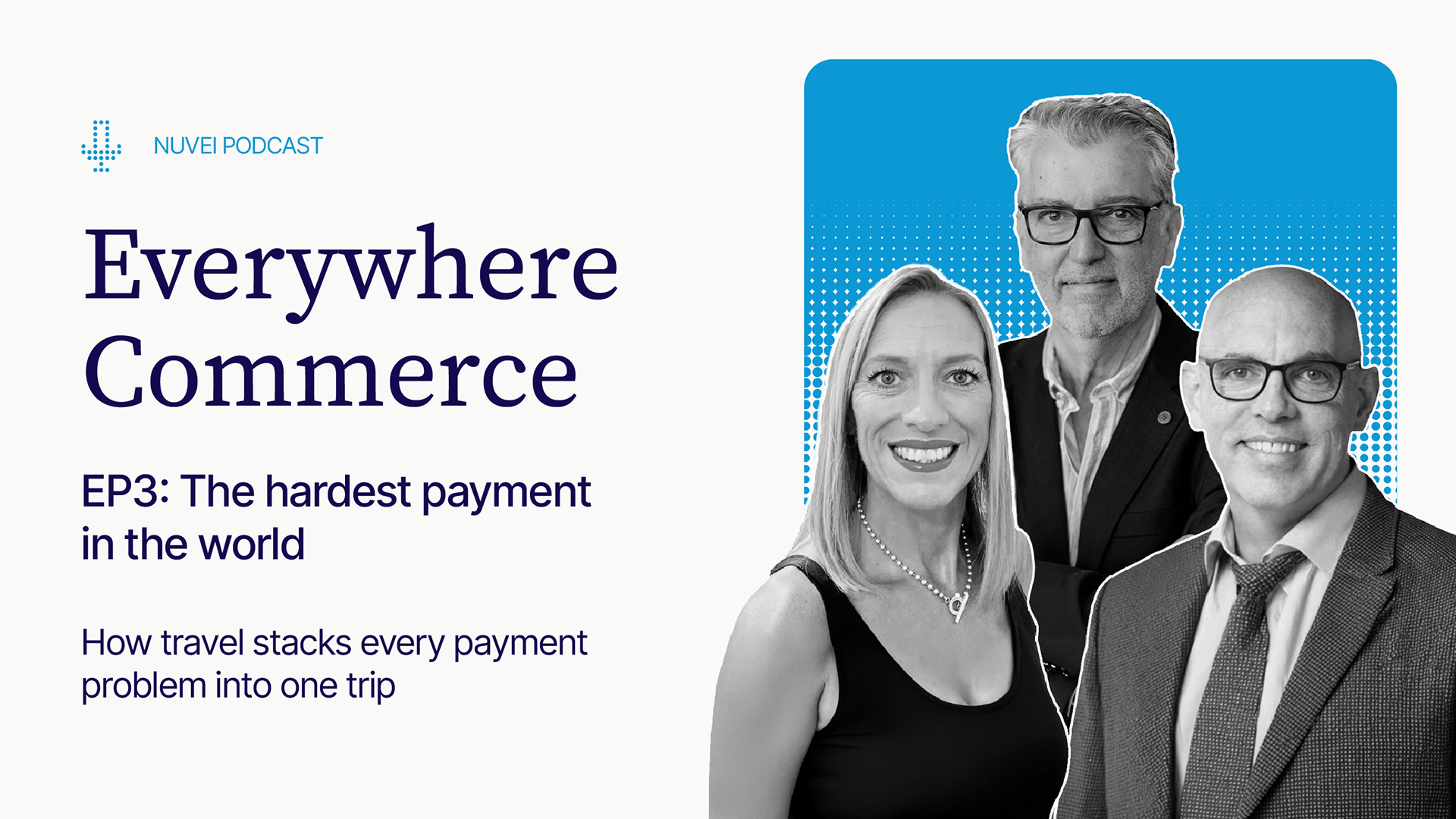
In Episode 4 of Nuvei’s Everywhere Commerce podcast, “Everybody’s business, nobody’s job,” host Siobhan O’Neill-Schwenk talks with two people who have seen this shift from different sides of the industry: Ben Weiner, of Nuvei; and Andres Ricaurte, of ECI to explore what it takes to build an embedded payments business that creates value for both the software company and its customers.
What this episode covers
In this episode, you’ll hear:
- Why payments often end up as “everybody’s business, nobody’s job,” and why that ambiguity keeps them stuck as a feature rather than a growth strategy.
- What changes when software companies stop measuring payment transactions and start measuring business outcomes, such as retention, adoption, revenue, and customer success.
- Why vertical-specific payment strategies matter, and why a generic payments offering rarely captures the full value of a specialized software platform.
- How companies monetize payments without turning them into a bolt-on revenue line that customers resent.
- Why executive ownership is often the difference between a payments initiative that stalls and one that reshapes the business.
- Where embedded working capital fits next, and why the future of payments may be less about moving money and more about understanding the context around it.
Meet the guests for this episode
Ben Weiner, Nuvei

Ben works with software companies building embedded payments into their platforms. His focus is on helping them turn payment capability into a durable growth business, with the operating model, metrics, and executive sponsorship to match.
In the episode, Ben explains why payments cannot remain a side project owned by no one, and why the companies that succeed treat them as a strategic business with clear accountability.
“Payments used to be a feature. Now, they’re becoming a business.”
– Ben Weiner, Nuvei
Andres Ricaurte, ECI

Andres brings an operator’s perspective to the conversation, with experience of executive-level transformation at leading software firms. He has seen what happens when payments move from the back office to the boardroom, and what it takes to make that shift stick.
In the episode, Andres explains why the real pain is not simply moving money, why industry-specific solutions unlock more value, and why the best payments strategies are built around customer outcomes.
“The real pain is that payment is more than moving money.”
– Andres Ricaurte, ECI
Key ideas from the episode
1. Payments become everybody’s business when nobody owns them
In many software companies, payments touch product, finance, operations, customer success, sales, and support. That breadth can be a strength, but it can also mean that no single leader is accountable for making payments work as a business.
The episode argues that the first shift is ownership: someone senior has to own the payments strategy, its economics, and its outcomes.
2. The difference between a feature and a business is everything
A payments feature is something you add to make a transaction possible. A payments business is something you build to improve customer outcomes, deepen platform value, and create sustainable growth.
That distinction changes the questions leadership asks. Instead of “Can we take a payment?” it becomes “What business outcome does this payment experience create, and how do we improve it?”
3. Payment is more than moving money
The conversation pushes back on the idea that payments are simply plumbing. A payment can carry context: who the customer is, what they are buying, how they operate, what they need next, and where friction is likely to appear.
For vertical software companies, that context is often the most valuable part of the platform.
4. Vertical-specific strategies unlock the real value
A generic payment experience can process a transaction, but it may miss what a particular industry actually needs. Construction, field services, healthcare, hospitality, and other verticals all have different workflows, payment rhythms, risk profiles, and customer expectations.
The guests argue that the winners design payments around those realities, rather than forcing every industry into the same model.
5. Monetization works best when adoption comes first
Payments can become a meaningful revenue stream, but monetization should not be the starting point. If customers do not adopt the payment experience, there is nothing to monetize.
The episode makes the case for building adoption around usefulness first, then developing pricing and monetization models that reflect the value created.
6. Measure company wins and customer wins
Payment success cannot be judged by transaction volume alone. Software companies need to understand both sides of the equation: what payments do for the business, and what they do for the customer.
That means looking beyond take rate to measures such as activation, adoption, retention, customer satisfaction, operational efficiency, and the outcomes customers achieve on the platform.
7. Embedded working capital is the next shift
The conversation looks ahead to embedded working capital: giving software platforms the ability to help customers manage cash flow at the moment they need it.
Done well, this is not simply another financial product bolted onto a platform. It is an extension of the platform’s understanding of its customers, their workflows, and the timing of their money.
8. The future of payments is context and people
As payments become more embedded, the technology matters, but so does judgment. The next phase will reward companies that understand the context around a payment and put the right people in charge of turning that context into customer value.
Why this matters if you sell software
If your platform helps businesses run their operations, payments may be one of the most underused growth levers you have. But treating it as a feature will only get you so far.
The companies that win treat payments as a business: owned at the executive level, designed around their vertical, measured by customer and company outcomes, and built for long-term growth.
Closing thoughts
Embedded payments succeed when they stop being everyone’s responsibility and become someone’s strategic mandate.
The opportunity is not just to move money more efficiently. It is to use payments to make the platform more useful, the customer more successful, and the software business more valuable. When payments are built as a business, they stop being a back-office task and start becoming a growth engine.
Stay ahead with Everywhere Commerce
Everywhere Commerce is a podcast produced by Nuvei, the infrastructure for every payment, everywhere. Each episode looks at how real payment systems, local methods, and emerging technologies like agentic commerce shape the way businesses grow across channels and borders.
If you’re building software and want to turn payments from a feature into a reason customers stay:
- Subscribe to Everywhere Commerce in your favorite podcast app.
- Follow Nuvei for new episodes, articles, and practical guidance on embedded payments.
- Share this episode with your product, payments, and growth teams to start a deeper conversation about who owns payments in your business.
Stay tuned,
Team Nuvei