Four kinds of trust: What Europe's first autonomous agent payment proved
An agent bought a T-shirt with no human at the payment step. Four things had to be true first: interoperability, agent identity, a validated mandate, and fraud models built for a buyer that isn't a person.

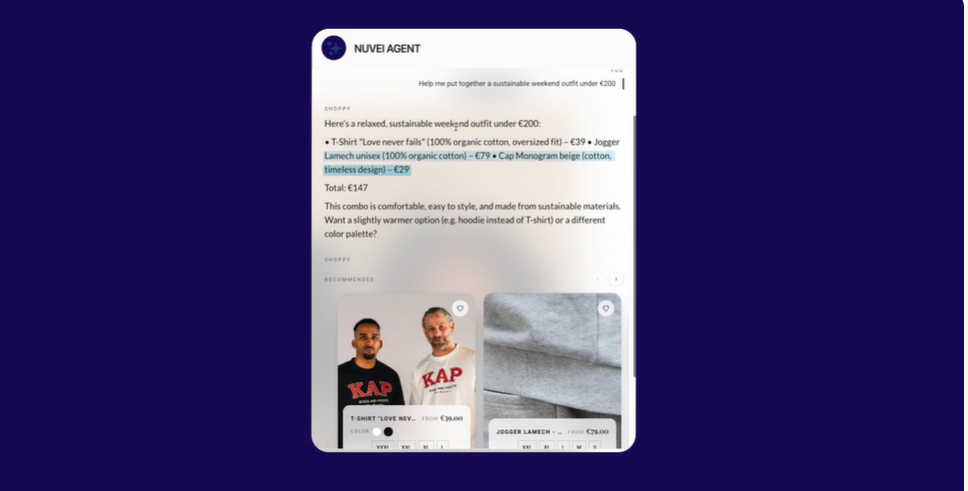
A customer asked an assistant to find a T-shirt for a friend. The assistant found one, showed it to her, and asked whether she wanted to buy it. She said yes. After that, she did nothing. The agent executed the purchase, Nuvei handled authorization and risk, Arvato handled commerce, and within minutes she received confirmation that the shirt would arrive in two days.
That was Europe's first fully autonomous agentic commerce transaction, completed with Visa, Arvato, and the fashion brand Kings and Priests. What made it genuinely agentic is that everything after “yes” happened inside the agent’s environment rather than on a merchant checkout page.
I came to agentic commerce from payments rather than AI, and that shapes how I read this moment. The models are already good enough to sell. What is not finished is the layer underneath them: the agreements, controls, and guarantees that allow a bank, a merchant, and a consumer to accept a purchase made by software none of them built.
Discovery has already moved. Payment has not.
Today, consumers are turning to LLMs for better product information, better price discovery, and a better decision-making experience. That behavior is real and growing. According to Nuvei’s How Agents Pay survey, 58% find AI useful for researching products and comparing prices.
Still, at the moment of payment, in almost all of those journeys, the consumer is handed back to a merchant checkout and completes a standard eCommerce transaction, much as they would have in 2016. That handoff is currently the core commercial problem for agentic commerce because discovery without execution means the agent influences the sale but cannot close it, and the merchant gains no new channel.
At its core, this is a trust gap: our data shows that only 1% of consumers want fully automated AI buying in 2026.
The purpose of our pilot was to prove that, with real issuers, a real card network, and a real merchant (not just in a demo environment) an agentic transaction can happen, and to surface what trust actually requires in practice.
Four kinds of trust: interoperability, identity, mandate, and risk.
1. Interoperability, or the translation problem
Agents do not speak a single language. Purchase intent arrives via emerging protocols, including ACP from OpenAI, UCP and AP2 from Google, and MCP from Microsoft. No merchant will build and maintain separate integrations for each, and none of these protocols speaks the language of authorization, tokenization, or scheme rules.
Interoperability is trust that intent can be understood and executed correctly.
Something has to sit in the middle and translate. That is what Nuvei is building as a Protocol Compatibility Layer: turning an agent instruction into a payment instruction without forcing merchants to carry the engineering burden of every new standard. A merchant integrates once and accepts whichever standard an agent uses. Payments route across both Visa’s and Mastercard’s agentic frameworks, with Nuvei certifying against Visa Intelligent Commerce and Mastercard Agent Pay.
2. Knowing the agent
Payments spent two decades learning how to know the merchant and the customer. Trust depends on attaching a transaction to an accountable identity.
Agents introduce a third party with no legal personality, created in seconds, operating at machine speed. Knowing the agent means credential validation, reputation over time, and an audit trail that holds up in a dispute. Without it, an issuer is being asked to approve a purchase from a party nobody can name.
Identity is trust that the actor is known and accountable.
Know Your Agent introduces that layer: registering and credentialing agents, validating the consumer’s mandate before any money moves, scoring the agent’s track record, and making every action auditable.
3. The mandate
A mandate is the instruction given to the agent: what it may buy, within what limits, on which card, and for how long.
Mandate is trust that the action is authorized and real.
It protects the consumer if something goes wrong and gives the merchant, network, and issuer a shared record of what was agreed. In the pilot, the credential passed through VisaNet carried that mandate with it, allowing every party to verify that the purchase fell within scope.
Agentic commerce does not scale on trust as sentiment. It scales on mandates that can be validated at authorization.
4. Fraud models trained on the wrong species
Fraud systems are built on human behavior: typing cadence, hesitation, device history, session patterns. Almost every signal we rely on assumes a person.
Agents behave differently. They do not hesitate, they do not browse like humans, and their velocity can resemble an attack under conventional models.
Risk is trust that the transaction is safe.
Agent-native fraud detection requires a new behavioral baseline for non-human buyers, built while volumes are still low enough to learn safely.
Consumers are not (yet) ready, and that is the argument for building now
According to Nuvei’s How America Pays survey, 60% say they prefer to wait and see how others use AI for purchasing before trying it themselves.
The obvious reading is that agentic commerce is early. A more useful reading is that consumers want to stay in the loop while trust is established, just as they did with contactless, wallets, and one-click checkout.
The implication is practical: infrastructure must support both modes. Purchases confirmed in the moment, and purchases pre-authorized through a mandate. Agentic commerce is forecast to drive more than $3 trillion in global transaction volume by 2030, and that scale will not arrive on infrastructure built after demand appears.
What the pilot was for
No single company can define these four layers of trust alone. The transaction required a network, an issuer, a commerce partner, a merchant, and a payment infrastructure provider to agree on what a valid agent purchase looks like. Today, no one thinks about the routing, fraud checks, or identity verification behind an online payment. That infrastructure became invisible because it became trustworthy. I am confidnent that agentic commerce will follow the same path.