OTA payments: The real cost between booking and departure
For OTAs, payment risk extends well beyond checkout. Here's how reserves, disputes, declines and future travel obligations affect margins and growth.


Earlier this year, I was sitting at a gate in Frankfurt when our connection to Lisbon was canceled. The traveler next to me had booked his trip through an online travel agency months earlier. Before the gate agent had finished the announcement, he’d opened his banking app to initiate a chargeback before the agency had had a chance to send him a refund.
For the traveler, the question was simple: who was going to give him his money back?
For the OTA, the answer depends on something the customer may never have considered: who actually took the payment, and who is responsible when the journey doesn’t go as planned? It’s a useful illustration of one of the biggest challenges in travel payments. The transaction may be completed in seconds, but the financial exposure can last for months. And for OTAs, that period between booking and travel is where some of the most significant payment costs and risks accumulate.
Who takes the payment matters
Not every OTA operates in the same way. For many airline bookings, the airline remains the merchant of record, processing the traveler’s payment while the OTA earns a commission. For packages, net-rate hotels or other merchant-model arrangements, the agency may collect the full payment and subsequently settle with the supplier.
That distinction matters. When the OTA is merchant of record, it has greater control over the payment experience and potentially the transaction economics. But it also takes on direct responsibility for payment acceptance, refunds, chargebacks and the exposure associated with services that have yet to be delivered. Even where the supplier takes the payment, the OTA remains an important part of the customer experience when cancellations, refunds or changes occur.
For an OTA managing millions of transactions across different suppliers and operating models, understanding where those responsibilities sit is fundamental.
The risk doesn’t disappear when the payment is approved
Travel is different from most retail transactions because customers often pay long before receiving the service. A flight booked in January for departure in August creates a very different risk profile from a product purchased and delivered the following day.
Under certain card scheme rules, disputes involving future services can be raised as late as 540 days after the original transaction, subject to the applicable conditions and deadlines. That is a long time for a transaction to remain exposed.
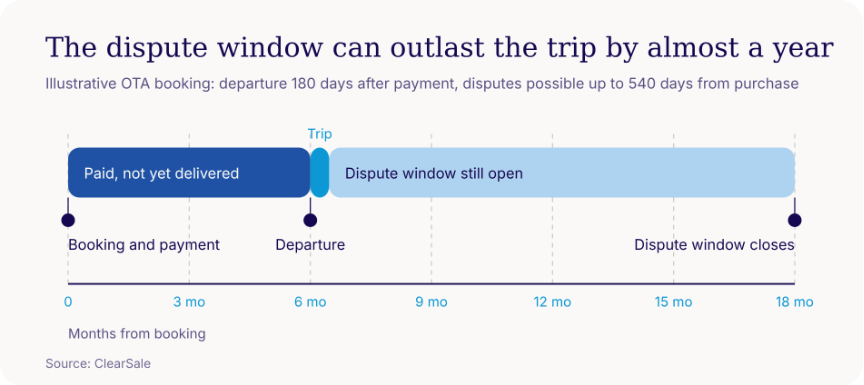
During that period, flights can be canceled, hotels can close, customers can change plans and suppliers can encounter financial difficulties. For OTAs acting as merchant of record, these events can result in refunds and chargebacks well after the original payment has settled.
Acquirers understand this exposure, which is why travel businesses can face rolling reserves, delayed settlements or other requirements designed to protect against future delivery risk. The consequence is that an OTA can be growing booking volumes and revenue while simultaneously seeing more of its working capital tied up. And if a wave of cancellations arrives, those obligations can quickly turn into a liquidity challenge.
The cost of payments is therefore not just the processing fee. It’s also the cost of managing the financial obligations that remain after checkout.
We went deeper on the complexities of travel payments in our Everywhere Commerce podcast episode, “The hardest payment in the world,” with Virgin Atlantic’s payment strategy lead. It’s a conversation that illustrates just how many moving parts sit behind what appears to the customer to be a straightforward transaction.
Disputes are becoming more expensive to ignore
There’s another reason why OTAs need to pay closer attention to what happens after a booking.
Visa’s Acquirer Monitoring Program (VAMP) combines fraud reports and disputes into a single monitoring framework, increasing the importance of managing both. In April 2026, the excessive merchant threshold fell from 2.2% to 1.5% in major markets including Europe and North America, subject to minimum dispute and fraud volumes. Acquirers face even tighter portfolio-level thresholds, with an excessive classification at 0.7% and an above-standard threshold beginning at 0.5%.
For travel businesses, where cancellations and refunds are a normal part of operations, this adds another dimension to payment risk. A legitimate booking can still become a dispute if a customer cannot obtain a refund, doesn’t understand who is responsible or becomes frustrated by delays.
The traveler at Frankfurt opening his banking app is a good example of how quickly that process can begin. This makes timely refunds, clear communication and automated dispute prevention commercially important, not simply customer service improvements.
Where possible, identifying a supplier cancellation and initiating the appropriate refund before the customer raises a dispute can reduce costs, protect the customer relationship and help maintain healthier acquiring performance.
The holiday peak exposes the weaknesses
The upcoming holiday season illustrates why this matters.
According to Hopper’s 2026 Holiday Travel Index, Thanksgiving airfares are averaging $402, up 31% year over year, while Christmas fares average $452, up 23%. Hopper advised travelers to secure flights and accommodation before Halloween to avoid further price increases.
For OTAs, earlier bookings and higher ticket values mean more money moving through payment systems well ahead of travel. For those operating as merchant of record, they can also mean higher future delivery exposure. And if disruption occurs during one of the busiest travel periods, cancellations, refunds and chargebacks can arrive in concentrated volumes.
The challenge isn’t limited to the holiday season. The same dynamics apply to summer travel, major events and any period when bookings are made significantly ahead of departure. The important question is whether an OTA understands that exposure before something goes wrong.
Better payments require more than better checkout
Much of the discussion around OTA payment optimization still focuses on improving conversion and reducing transaction fees. Both are important. But they only address part of the opportunity.
Declines, for example, can result from cross-border acquiring arrangements, insufficient transaction data or outdated card credentials. Local acquiring, better use of travel-related data and network tokens can all help improve authorization performance, depending on the market and payment flow.
Meanwhile, payment orchestration can give OTAs greater flexibility in how transactions are routed and processed. But improving acceptance at checkout needs to sit alongside better management of what happens afterwards.
That means understanding future travel exposure, aligning acquiring arrangements with the underlying business model, automating refunds where possible and ensuring that payments, risk and treasury teams are working from the same information.
An OTA may be optimizing conversion while overlooking the cost of reserves, disputes or inefficient supplier settlement arrangements. These are not separate payment problems. They are different parts of the same transaction lifecycle.
Three questions worth asking before the next peak
For OTA payment leaders, I would start with three questions:
- How much of our forward-booked volume are we financially exposed to? And can we distinguish that exposure between transactions where the supplier is merchant of record and those where we are?
- What happens when a supplier cancels? Can we identify the affected booking and initiate a refund before the customer turns to their bank?
- Why are our payments being declined? Are we losing transactions because of cross-border acquiring, missing travel data or outdated card credentials, and do we have the right tools to address those issues?
These are practical questions, but the answers have a direct impact on profitability, liquidity and customer experience.
For too long, the industry has tended to measure payment performance at the point of sale. Yet for travel businesses, particularly OTAs managing multiple suppliers, markets and payment models, the transaction doesn’t really end until the service has been delivered and the financial obligations are settled. The next opportunity in OTA payments isn’t simply to make checkout more efficient. It’s to manage the entire financial lifecycle of a booking and turn that visibility into more profitable growth.